Real-Time Restaurant Vision Pipeline on AWS for Ocumentis
Proof of concept that moves Ocumentis’ GPU-based entrance monitoring from an on-site server to Amazon EKS, with a GPU node that only runs during opening hours.
Overview
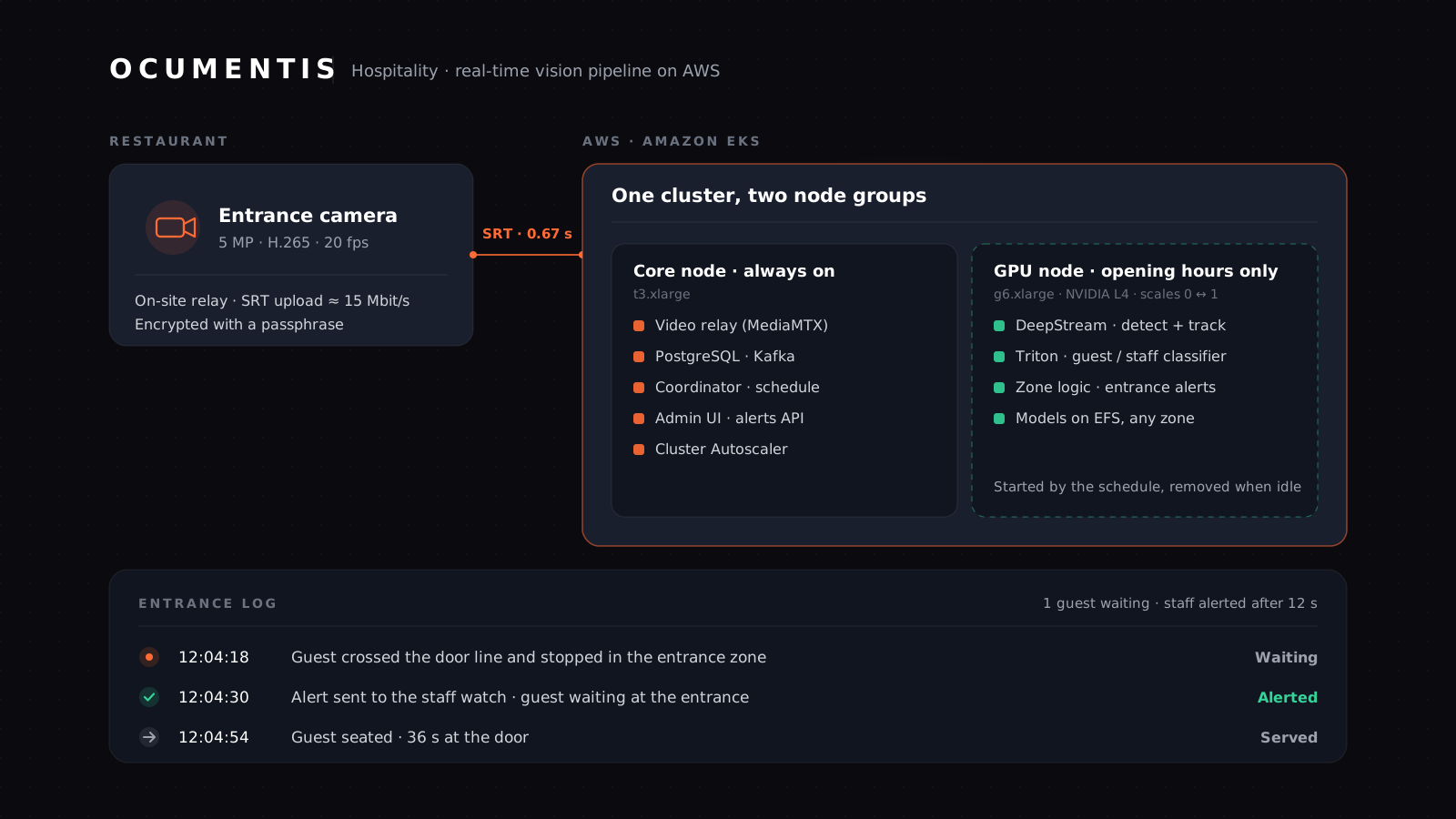
Ocumentis turns cameras into visual AI agents for hospitality, healthcare and retail: the system watches a space in real time and alerts staff when something needs attention, for example a guest waiting at the restaurant entrance. Today the product runs on a GPU server inside each venue. DataMax built a proof of concept that runs the same pipeline on AWS with one live entrance camera, to find out what a cloud version costs, how the video gets there, and whether detection quality holds.
Challenge
Every restaurant currently needs its own GPU server on site. For a cloud version, three things were open. The camera video (5 megapixels, H.265, about 15 Mbit/s per camera) has to cross the venue’s internet connection reliably and with low delay. The GPU is the biggest cost and should not run around the clock. And the detection and uniform classifier had only ever seen full-quality video from inside the restaurant, so nobody knew how much compression the pipeline could take.
Approach
One camera, measure before deciding. We deployed the Ocumentis Helm chart to Amazon EKS with minimal changes to their code, replaced the video transport with an SRT stream into a small relay inside the cluster, and built a test lab that plays recorded entrance footage through a simulated venue uplink at different speeds, resolutions and bitrates. Every run recorded transport delay, frame loss, and whether guests and staff at the door were recognised correctly.
Solution
The cluster has two node groups: a small always-on node for the database, Kafka, the coordinator and the admin UI, and a GPU node (NVIDIA L4) that the Cluster Autoscaler starts only while the pipeline is scheduled to run, following the restaurant’s opening hours. Video arrives over SRT through a Network Load Balancer, encrypted with a passphrase, and a MediaMTX relay hands it to DeepStream over RTSP with a black-frame fallback, so a dropped connection never stops the pipeline. Models live on EFS so the GPU node can start in either availability zone, application data sits on EBS, secrets come from AWS Secrets Manager and images from ECR. The setup is documented step by step so Ocumentis can rebuild it in any account.
Results
Ready to accelerate your AI journey?
Let's talk about your data and AI challenges. We'll help you build the right strategy and execute with speed.
Get in Touch